
Modern workplaces have evolved dramatically over the last decade. Companies are no longer satisfied with traditional office layouts filled with high cubicle walls, dark meeting rooms, and isolated workstations. Instead, organizations are embracing flexible work environments that encourage collaboration while still supporting individual focus. One design element has become increasingly popular in this transformation: glass partitions for office productivity.
At first glance, glass partitions appear to be nothing more than an attractive architectural feature. Their sleek appearance creates an elegant office environment that immediately impresses clients and employees alike. However, beneath their modern aesthetic lies a powerful productivity tool capable of improving communication, maximizing natural light, enhancing employee well-being, and making office spaces significantly more efficient.
Business leaders constantly seek ways to improve performance without dramatically increasing operational costs. While investments in software, employee training, and technology often receive the most attention, the physical workspace has an equally profound influence on productivity. Studies consistently demonstrate that workplace design affects employee concentration, creativity, collaboration, motivation, and even long-term job satisfaction. Office environments that support these factors naturally produce higher-performing teams.
This comprehensive guide explores every aspect of glass partitions for office productivity from a professional perspective. Rather than focusing solely on appearance, we’ll examine the science behind workplace psychology, office planning strategies, acoustic performance, lighting optimization, employee wellness, operational efficiency, and long-term return on investment. Whether you’re renovating a small office or designing a corporate headquarters, this guide will help you understand how glass partitions contribute to measurable business success.
Why Modern Businesses Are Replacing Traditional Office Walls
Traditional office layouts were originally designed to maximize privacy and separate departments. While this approach offered some benefits, it often created communication barriers, restricted natural light, and made offices feel cramped. Employees working inside enclosed spaces frequently experienced reduced interaction with colleagues, leading to slower decision-making and weaker collaboration.
Today’s organizations operate very differently. Cross-functional teams work together on projects that require constant communication and rapid information sharing. As businesses become more agile, office layouts must evolve accordingly. Modern companies need environments that balance openness with privacy while remaining adaptable to changing business needs.
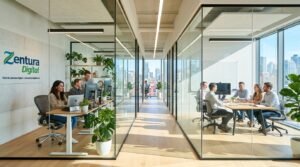
Glass office partitions provide this balance exceptionally well. Unlike permanent drywall structures, they create clearly defined workspaces without sacrificing visibility or openness. Employees can maintain visual connections with teammates while still benefiting from dedicated meeting rooms, private offices, and quiet work areas.
Another significant reason businesses are moving toward office glass partitions is employee satisfaction. Modern professionals increasingly value workplaces that feel bright, spacious, and welcoming. A thoughtfully designed office communicates professionalism, innovation, and organizational culture. Employees are more likely to enjoy coming to work in environments that prioritize comfort, transparency, and functionality.
Perhaps the greatest advantage is flexibility. Businesses grow, departments expand, and organizational structures change regularly. Glass partition systems can often be reconfigured more efficiently than traditional walls, reducing renovation costs and minimizing workplace disruption.
The Science Behind Office Productivity and Workspace Design
The Psychology of Physical Work Environments
Human behavior is heavily influenced by surroundings. Environmental psychology has repeatedly demonstrated that workplace design affects mood, motivation, concentration, and cognitive performance. Employees subconsciously respond to lighting, openness, noise levels, spatial organization, and visual stimulation throughout their workday.
Poor office layouts often contribute to unnecessary stress. Narrow corridors, dark workspaces, enclosed offices, and limited visibility create psychological barriers that reduce collaboration. Workers may feel disconnected from colleagues, making communication less frequent and teamwork less effective.
Glass office walls transform these psychological dynamics by creating visual openness. Employees perceive their workspace as larger and more inviting, reducing feelings of confinement. The transparent nature of glass encourages interaction while maintaining organizational structure.
This increased visibility also supports stronger workplace culture. Teams naturally become more approachable when colleagues can easily see one another. Informal conversations occur more frequently, knowledge sharing improves, and employees become more comfortable seeking assistance when needed.
Natural Light Directly Influences Employee Performance
One of the most overlooked contributors to workplace productivity is access to natural daylight. Traditional drywall partitions often block sunlight from reaching interior workspaces, forcing businesses to rely heavily on artificial lighting throughout the day.
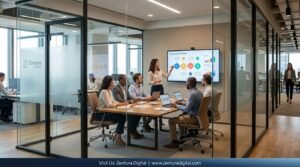
Glass partitions solve this problem by allowing daylight to penetrate deep into office interiors. Instead of being confined to perimeter offices, sunlight reaches meeting rooms, collaborative spaces, and employee workstations more evenly.
Improved daylight exposure offers numerous measurable benefits. Employees generally experience better concentration, increased alertness, reduced eye strain, and improved mood. Natural light also supports healthier circadian rhythms, contributing to better sleep quality and higher daytime energy levels.
Organizations that maximize daylight often report lower absenteeism and improved employee satisfaction. While lighting alone cannot solve every productivity challenge, it forms a critical component of an optimized workplace environment.
Transparency Builds Organizational Trust
Office design communicates organizational values. Companies emphasizing openness frequently choose transparent architectural elements because they reinforce cultures built on communication and accountability.
Glass partitions visually remove barriers between leadership and employees. Managers remain accessible while still maintaining functional office spaces. This visibility encourages more frequent interaction and helps reduce perceived organizational hierarchy.
Employees working in transparent environments often feel more connected to company activities. Seeing meetings, collaborative discussions, and daily operations creates a stronger sense of inclusion, even when individuals are not directly involved.
Of course, transparency should be balanced with privacy. Frosted glass, switchable smart glass, decorative films, and acoustic meeting rooms provide confidentiality where necessary without sacrificing the overall openness of the workspace.
How Glass Partitions Improve Collaboration Without Creating Chaos
Open Communication With Defined Workspaces
Completely open-plan offices gained popularity because they encouraged communication. However, many organizations later discovered that unrestricted openness often produced excessive distractions and noise.
Glass partitions solve this challenge by combining openness with organization. Departments remain visually connected while physical separation helps define functional work zones.
Meeting rooms enclosed with glass maintain transparency while reducing interruptions to surrounding employees. Team discussions become more productive because participants have dedicated spaces without completely isolating themselves from the rest of the office.
Similarly, project teams benefit from collaborative rooms equipped with writable glass walls, digital displays, and flexible seating. These environments encourage brainstorming while minimizing disruptions to nearby workstations.
Improved Knowledge Sharing Across Departments
Innovation often emerges when employees from different disciplines interact naturally. Marketing teams may gain valuable insights from sales professionals, while product developers benefit from customer service feedback.
Traditional enclosed offices reduce these spontaneous interactions. Glass office layouts increase visual awareness, making it easier for colleagues to identify opportunities for collaboration.
Employees become more likely to approach one another with questions, ideas, or project updates. These seemingly minor interactions accumulate over time, strengthening organizational knowledge sharing.
This enhanced communication becomes especially valuable in fast-paced industries where rapid decision-making directly influences competitive advantage.
Creating Productive Meeting Spaces
Meetings consume a substantial portion of the average employee’s workweek. Unfortunately, poorly designed meeting rooms often reduce productivity rather than improve it.
Glass meeting rooms provide professional environments that encourage engagement while maintaining visual connection to the office. Participants feel less isolated, and the transparency naturally promotes concise, focused discussions.
Acoustic laminated glass further enhances meeting effectiveness by preventing conversations from disturbing nearby employees. This combination of openness and sound control creates ideal environments for brainstorming sessions, client presentations, strategic planning, and confidential discussions.
Supporting Hybrid Work Environments
Hybrid work has permanently changed office design priorities. Today’s workplaces must accommodate employees who split time between remote and in-office work.
Glass partitions help organizations create flexible collaboration spaces where teams can easily connect both physically and virtually. Conference rooms equipped with video conferencing technology become brighter, more inviting, and more effective when enclosed with glass instead of opaque walls.
Employees returning to the office experience greater engagement because the workspace feels dynamic rather than isolated. The visual openness also makes it easier for hybrid teams to identify available meeting rooms and collaborative spaces.
Boosting Focus Without Sacrificing Openness
One of the biggest criticisms of open-plan offices is the constant stream of distractions. Conversations, ringing phones, impromptu meetings, and foot traffic can interrupt concentration multiple times each hour. Research has consistently shown that after an interruption, employees often require several minutes to fully regain their focus. Over an entire workday, these interruptions accumulate into a significant productivity loss. This is where glass partitions for office productivity offer a more balanced solution than either completely open spaces or fully enclosed offices.
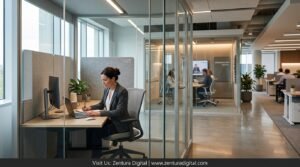
Unlike traditional cubicles that isolate employees or open layouts that expose everyone to constant activity, office glass partitions establish clear visual and physical boundaries. Employees can remain aware of their surroundings without feeling overwhelmed by every movement or conversation. The transparent nature of the partitions maintains a sense of openness while reducing unnecessary disruptions. This balance is particularly valuable for knowledge workers whose performance depends on sustained concentration and analytical thinking.
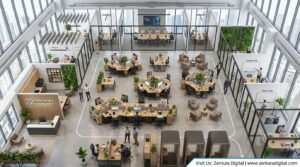
Glass partitions also create designated zones for different types of work. Quiet areas can be reserved for tasks requiring deep focus, while collaborative spaces remain available for brainstorming, meetings, and team discussions. By separating these functions, organizations enable employees to choose environments that best match their current tasks. This intentional zoning improves both efficiency and employee satisfaction because workers spend less time battling distractions.
Another overlooked benefit is the psychological effect of having a defined workspace. Employees generally feel more organized and in control when their work area has clear boundaries. Even though glass walls are transparent, they subtly communicate ownership of space, helping individuals mentally transition into focused work without feeling isolated from the rest of the office.
Creating Dedicated Focus Zones
Not every employee performs the same type of work. Accountants analyzing financial reports, software developers writing code, designers creating visual assets, and legal professionals reviewing contracts all require uninterrupted concentration. Attempting to complete these tasks in a noisy environment often leads to reduced accuracy and increased stress.
Glass partitions make it possible to create dedicated focus zones without sacrificing the collaborative culture many organizations value. These areas can incorporate acoustic glass, soft furnishings, and sound-absorbing materials to further minimize distractions. Employees working in these spaces enjoy the benefits of natural light while experiencing fewer interruptions than they would in an open-plan office.
The transparency of glass walls also reduces feelings of isolation that sometimes occur in traditional enclosed offices. Workers remain visually connected to colleagues and office activity, which supports engagement while preserving concentration. This combination of visibility and privacy contributes to a healthier and more productive workplace.
Businesses can further optimize these zones by integrating adjustable lighting, ergonomic furniture, and climate controls. When environmental factors align with thoughtful space planning, employees are better equipped to maintain high levels of performance throughout the workday.
Reducing Visual Clutter
Productivity is influenced not only by noise but also by visual distractions. Constant movement in an open office can draw employees’ attention away from important tasks, increasing cognitive load and reducing efficiency.
Strategically positioned glass partitions help guide sightlines and reduce unnecessary visual clutter. Frosted sections, decorative films, or partially opaque designs can shield particularly distracting areas while preserving overall openness. These subtle adjustments allow businesses to create calmer work environments without resorting to completely solid walls.
A clean and organized visual environment also supports professionalism. Clients visiting the office are greeted with an uncluttered, modern workspace that reflects attention to detail and operational excellence. Employees benefit from an environment that feels structured rather than chaotic, reinforcing positive work habits.
As organizations continue to embrace flexible work arrangements, minimizing both auditory and visual distractions becomes increasingly important. Glass office walls provide an adaptable solution that supports focus without compromising collaboration.
Acoustic Performance: The Truth About Soundproof Glass Partitions
A common misconception is that all glass partitions are noisy. In reality, modern soundproof glass partitions can deliver impressive acoustic performance when properly specified and installed. The key lies in selecting the appropriate glazing system, frame design, seals, and installation method.
Single-pane glass provides limited sound reduction and is generally suitable only for spaces where privacy is not a primary concern. Double-glazed systems, laminated acoustic glass, and specialized seals significantly improve sound insulation, making them ideal for executive offices, meeting rooms, and confidential workspaces.
Acoustic ratings such as STC (Sound Transmission Class) provide a standardized way to compare the sound-blocking capabilities of different partition systems. Businesses should evaluate these ratings carefully when designing offices that require speech privacy or reduced ambient noise.
Proper installation is equally important. Even high-performance glass can underperform if gaps around frames or doors allow sound to leak. Working with experienced installers ensures that acoustic systems achieve their intended performance.
Balancing Transparency and Privacy
Privacy remains a legitimate concern in many workplaces. Human resources discussions, legal consultations, financial planning meetings, and executive conversations all require confidentiality. Fortunately, modern glass partition systems offer multiple solutions that preserve both openness and discretion.
Frosted films, gradient designs, switchable smart glass, and decorative patterns can provide visual privacy without completely blocking light. Smart glass technology is particularly innovative, allowing users to switch between transparent and opaque modes at the touch of a button. This flexibility enables meeting rooms to adapt to different activities throughout the day.
Acoustic privacy can also be enhanced through careful material selection. Laminated acoustic glass incorporates specialized interlayers that absorb sound vibrations, reducing speech transmission between rooms. Combined with high-quality seals and doors, these systems create private environments while maintaining the aesthetic advantages of glass.
Organizations should assess the privacy requirements of each department before selecting partition systems. Different areas may benefit from varying levels of transparency, acoustic performance, and flexibility.
Supporting Confidential Collaboration
Many business discussions require both collaboration and discretion. Product development, strategic planning, recruitment interviews, and client negotiations all involve sensitive information. Glass partitions enable these activities to occur in spaces that remain visually integrated with the office while protecting confidential conversations.
Dedicated collaboration rooms equipped with acoustic glass encourage teams to work together without disturbing neighboring employees. Integrated technology such as interactive displays, video conferencing equipment, and writable glass walls further enhances productivity within these spaces.
By combining transparency, functionality, and privacy, organizations create environments that support innovation while protecting sensitive information. This balanced approach aligns with the needs of modern businesses operating in competitive industries.
Employee Wellness and Workplace Satisfaction
Employee well-being has become a strategic priority for organizations seeking to attract and retain top talent. Modern workers increasingly evaluate employers not only on compensation but also on workplace quality, flexibility, and overall experience. Office design plays a crucial role in shaping these perceptions.
Glass office partitions contribute to wellness by creating brighter, more inviting environments. Increased access to natural light supports healthier sleep patterns, improves mood, and reduces fatigue. Employees who spend their days in well-lit spaces often report higher levels of satisfaction and engagement compared to those working in enclosed, artificially lit environments.
The sense of openness created by glass walls also reduces feelings of confinement. Spacious environments encourage movement, interaction, and a greater sense of comfort throughout the workday. These factors collectively contribute to improved morale and stronger organizational culture.
Wellness extends beyond physical comfort. Employees who feel connected to colleagues and leadership are generally more motivated and committed to organizational goals. Transparent office layouts reinforce this connection by promoting visibility and accessibility across departments.
Encouraging Movement and Interaction
Modern office design increasingly recognizes the importance of physical movement. Employees who remain seated for extended periods may experience reduced energy, musculoskeletal discomfort, and decreased productivity.
Glass partitions support layouts that encourage employees to move naturally between collaborative spaces, meeting rooms, quiet zones, and social areas. Because these spaces remain visually connected, employees navigate the office more intuitively, promoting healthy movement throughout the day.
Informal interactions also become more common in visually open environments. Brief conversations between colleagues often lead to knowledge sharing, problem-solving, and stronger interpersonal relationships. These seemingly small exchanges contribute significantly to organizational innovation over time.
Employers can enhance these benefits by integrating ergonomic furniture, wellness rooms, standing workstations, and biophilic design elements alongside glass partition systems.
Maximizing Office Space Planning
Real estate represents one of the largest operational expenses for many organizations. Efficient office space planning therefore has a direct impact on profitability. Glass partitions enable businesses to maximize usable space while maintaining an attractive and functional environment.
Unlike bulky drywall construction, slim glass systems occupy less physical space and create the perception of larger interiors. This visual expansion allows businesses to accommodate more employees without making the office feel crowded.
Glass partition systems are also highly adaptable. As organizations grow or restructure, walls can often be relocated or reconfigured with far less disruption than traditional construction. This flexibility reduces renovation costs and extends the lifespan of office layouts.
Effective space planning also supports departmental workflows. Teams that collaborate frequently can be positioned closer together, while quieter functions occupy dedicated focus areas. Glass partitions make these arrangements possible without sacrificing visibility or access to daylight.
Designing for Future Growth
Successful businesses rarely remain static. Expansion, mergers, evolving technologies, and changing work styles all influence office requirements over time. Investing in flexible infrastructure allows organizations to adapt more efficiently.
Modular glass partition systems are specifically designed for future reconfiguration. Rather than demolishing permanent walls during renovations, businesses can relocate partition panels to create new offices, meeting rooms, or collaborative spaces. This approach minimizes waste, reduces downtime, and lowers long-term construction costs.
Future-proofing also involves integrating technology. Many contemporary glass systems accommodate electrical wiring, audiovisual equipment, access controls, and smart building technologies. Planning for these capabilities during initial installation reduces future retrofit expenses.
Organizations that view office design as an evolving asset rather than a fixed expense are better positioned to respond to changing business needs while maintaining productivity.
Sustainability and Energy Efficiency
Environmental responsibility has become a core business objective for organizations worldwide. Sustainable office design not only reduces environmental impact but also lowers operating costs and enhances corporate reputation.
Glass partitions contribute to sustainability by maximizing daylight penetration, reducing reliance on artificial lighting during business hours. Increased natural illumination lowers electricity consumption and creates more comfortable work environments.
Many manufacturers now produce glass using recycled materials and environmentally responsible production methods. Businesses pursuing green building certifications often include glass partition systems as part of broader sustainability strategies.
Energy-efficient glazing options further improve performance by reducing heat transfer while maintaining excellent visibility. Combined with intelligent lighting controls and HVAC optimization, these systems contribute to significant long-term operational savings.
Measuring Return on Investment
Although premium glass partition systems typically require higher upfront investment than basic drywall construction, their long-term value often exceeds initial costs. Productivity improvements, reduced renovation expenses, increased employee satisfaction, and lower energy consumption collectively contribute to favorable returns on investment.
Organizations should evaluate both tangible and intangible benefits when calculating ROI. While energy savings and maintenance costs are easily measured, improvements in employee retention, workplace culture, and client perception also deliver substantial financial value over time.
Flexible partition systems additionally reduce future remodeling expenses by enabling reconfiguration without major demolition. This adaptability becomes increasingly valuable as businesses evolve.
When considered over the lifespan of the office, glass partitions for office productivity frequently represent one of the most strategic investments organizations can make in their physical workplace.
Choosing the Right Glass Partition System
Selecting the ideal glass partitions for office productivity requires more than comparing prices or aesthetics. Every organization has unique operational needs, employee workflows, branding goals, and budget constraints. The most successful office projects begin with a comprehensive workplace assessment that identifies how employees interact, which departments require privacy, and where collaboration naturally occurs.
Business leaders should first determine the primary objective of the partition system. Some offices prioritize openness and natural light, while others require exceptional acoustic performance for confidential meetings. Hybrid workplaces often need flexible spaces that can quickly adapt to changing team sizes and work patterns. Understanding these priorities ensures the selected system supports long-term business objectives rather than simply improving appearance.
Material quality is another essential consideration. Tempered safety glass is the industry standard due to its strength and durability, while laminated acoustic glass provides superior sound insulation. Frame materials, hardware quality, and door systems also influence long-term performance. Investing in premium components reduces maintenance costs and extends the lifespan of the installation.
Future scalability should never be overlooked. Organizations experiencing growth benefit from modular systems that can be reconfigured without extensive demolition. These adaptable solutions provide excellent long-term value because office layouts can evolve alongside the business.
Frameless vs. Framed Glass Partitions
Frameless glass partitions have become increasingly popular because they deliver a clean, minimalist appearance. Their uninterrupted transparency maximizes natural light, creates an impression of spaciousness, and complements modern architectural styles. Businesses seeking a premium corporate image often choose frameless systems for executive offices, conference rooms, and client-facing spaces.
Framed systems, on the other hand, provide additional structural support and may offer improved acoustic performance depending on the design. Aluminum frames are available in various finishes that integrate seamlessly with different interior styles. These systems are particularly well suited for high-traffic environments requiring exceptional durability.
The decision ultimately depends on operational priorities. Companies emphasizing visual elegance may favor frameless installations, while organizations requiring enhanced sound control or cost efficiency may prefer framed solutions. Consulting experienced office designers helps balance these considerations effectively.
Installation Best Practices
Future Trends in Glass Partitions for Office Productivity
Even the highest-quality partition system will fail to deliver its full benefits if installation is poorly executed. Professional planning begins with accurate measurements, detailed architectural drawings, and coordination between designers, contractors, and facility managers. Every component—from floor alignment to ceiling connections—must be precisely installed to ensure structural integrity and optimal performance.
Acoustic performance depends heavily on installation quality. Gaps around doors, ceilings, or frames can significantly reduce sound insulation. Proper sealing, premium hardware, and carefully aligned glazing are essential for maintaining privacy in meeting rooms and executive offices.
Safety regulations must also be considered throughout the installation process. Tempered or laminated safety glass should comply with local building codes, and all hardware must be capable of supporting the intended loads. Emergency exit requirements, accessibility standards, and fire safety regulations should be integrated into the overall design.
Finally, organizations should schedule installations to minimize workplace disruption. Phased implementation allows employees to continue working while improvements are completed, reducing downtime and maintaining business continuity.
Common Mistakes Businesses Should Avoid
Best Practices for Implementing Glass Partitions for Office Productivity
Many organizations invest in beautiful office glass partitions but fail to realize their full productivity potential because of avoidable planning mistakes.
One common error is focusing exclusively on aesthetics while ignoring acoustics. Transparent meeting rooms may look impressive, but without appropriate sound insulation they become unsuitable for confidential discussions. Balancing design and functionality is essential.
Another frequent mistake is poor space planning. Installing partitions without understanding employee workflows can create bottlenecks, reduce collaboration, or leave valuable floor space underutilized. Effective office planning always begins with analyzing how teams actually work rather than simply dividing available space.
Some businesses also underestimate future growth. Choosing fixed, non-modular systems may reduce initial costs but increase renovation expenses later. Investing in flexible partition solutions supports organizational agility and lowers long-term operational costs.
Finally, neglecting employee input can undermine the success of an office redesign. Employees interact with the workspace every day and often provide valuable insights into collaboration challenges, privacy needs, and workflow improvements. Including them in the planning process increases acceptance and overall project success.
- Glass partitions for office productivity have become one of the most effective workplace design solutions for modern businesses.
- Companies investing in glass partitions for office productivity often experience improved employee engagement.
- Architects frequently recommend glass partitions for office productivity when designing flexible office layouts.
- Proper planning ensures glass partitions for office productivity deliver long-term business value.
- Every organization can customize glass partitions for office productivity based on operational needs.
- Investing in glass partitions for office productivity helps businesses create healthier workplaces.
- High-quality glass partitions for office productivity improve both aesthetics and functionality.
- Many commercial offices choose glass partitions for office productivity to encourage collaboration.
- Modern office renovations frequently include glass partitions for office productivity because they maximize natural light.
- Choosing premium glass partitions for office productivity reduces maintenance costs.
- Designers consider glass partitions for office productivity an essential feature of contemporary workplaces.
- Business owners increasingly recognize that glass partitions for office productivity improve employee satisfaction.
- Office planners integrate glass partitions for office productivity into both small and large commercial spaces.
- Flexible glass partitions for office productivity support changing organizational needs.
- Sustainable workplaces often incorporate glass partitions for office productivity into green building strategies.
- Acoustic solutions enhance glass partitions for office productivity in confidential meeting rooms.
- Well-designed glass partitions for office productivity create a balance between openness and privacy.
- The success of glass partitions for office productivity depends on careful planning and professional installation.
- Organizations choosing glass partitions for office productivity often report better workplace communication.
- Long-term ROI makes glass partitions for office productivity a valuable investment.
Advanced Case Study: How Glass Partitions Transformed Workplace Productivity
Common Myths About Glass Partitions for Office Productivity
Consider a mid-sized technology company employing approximately 180 people. The organization had grown rapidly over five years, but its office layout remained largely unchanged. Departments operated from enclosed offices separated by traditional drywall partitions, limiting communication between software development, marketing, sales, and customer support teams. Employees frequently complained about delayed decision-making, inadequate meeting space, and limited access to natural light.
After conducting a workplace assessment, leadership implemented a comprehensive redesign centered on glass partitions for office productivity. Executive offices, meeting rooms, collaboration areas, and focus zones were rebuilt using modular acoustic glass systems. Natural daylight was redistributed throughout the office by replacing opaque walls with transparent partitions. Departments requiring confidentiality received laminated acoustic glass and smart privacy film for sensitive discussions.
The redesign also introduced dedicated collaboration rooms equipped with writable glass walls, video conferencing technology, and flexible furniture. Quiet work zones were strategically positioned away from high-traffic areas, while social spaces encouraged informal interaction between departments. The modular partition system ensured future expansion could occur without extensive structural renovations.
Within several months, management observed measurable improvements across multiple performance indicators. Employees reported greater satisfaction with the workplace environment, citing improved access to daylight, better communication, and reduced feelings of isolation. Cross-department collaboration increased because teams could easily identify when colleagues were available for discussion. Project coordination became more efficient, reducing delays caused by communication barriers.
Meeting efficiency also improved. Acoustic conference rooms enabled confidential discussions without disturbing nearby employees, while transparent walls encouraged concise and focused meetings. Managers found that employees spent less time searching for available meeting spaces because room occupancy remained visually apparent.
The organization also experienced operational benefits beyond productivity. Electricity consumption decreased as natural daylight reduced dependence on artificial lighting during business hours. The modular partition system simplified departmental reorganization following company growth, avoiding costly demolition and reconstruction. Clients visiting the office consistently commented on its modern, professional appearance, reinforcing the company’s innovative brand image.
Although the initial investment exceeded the cost of conventional drywall construction, leadership concluded that improved productivity, employee retention, operational flexibility, and reduced renovation expenses generated an excellent long-term return on investment. The project demonstrated that thoughtful workplace design directly supports organizational performance rather than serving as merely an aesthetic enhancement.
Frequently Asked Questions
Is glass suitable for offices requiring privacy?
Yes. Modern office glass partitions provide multiple privacy solutions, including frosted films, decorative patterns, laminated acoustic glass, and electronically switchable smart glass. These technologies allow organizations to balance openness with confidentiality according to the function of each workspace.
Speech privacy depends primarily on acoustic design rather than transparency alone. Properly installed laminated glass with high-quality seals can significantly reduce sound transmission, making it appropriate for executive offices, legal consultations, financial meetings, and human resources discussions.
- How do glass partitions for office productivity reduce workplace distractions?
- Are glass partitions for office productivity suitable for hybrid offices?
- Can glass partitions for office productivity improve employee wellness?
- What industries benefit most from glass partitions for office productivity?
- How much do glass partitions for office productivity cost?
Do glass partitions actually improve productivity?
They can significantly improve productivity when integrated into a well-designed workplace strategy. Increased natural light, improved visibility, better collaboration, enhanced space planning, and reduced psychological barriers all contribute to higher workplace performance.
However, productivity gains depend on thoughtful implementation. Businesses should combine glass partitions with acoustic planning, ergonomic furniture, appropriate lighting, and clearly defined work zones to achieve the greatest benefits.
Are glass partitions expensive to maintain?
Compared with traditional walls, maintenance requirements are generally low. Routine cleaning using appropriate glass products keeps surfaces clear and professional. Premium tempered and laminated glass is highly durable and resistant to everyday wear.
Unlike painted drywall, glass does not require frequent repainting or repairs caused by dents and scratches. Over time, many organizations find maintenance costs comparable to—or even lower than—traditional construction.
Can existing offices be retrofitted with glass partitions?
Why Glass Partitions for Office Productivity Are a Smart Investment
Yes. Most commercial buildings can accommodate glass partition systems during renovation projects. Professional designers assess structural conditions, ceiling heights, HVAC systems, electrical infrastructure, and building regulations before recommending suitable solutions.
Modular systems are especially advantageous because they integrate efficiently into existing offices while minimizing disruption during installation.
Which industries benefit most from glass office partitions?
Nearly every commercial sector can benefit. Technology companies appreciate collaborative environments, legal firms require confidential meeting spaces, healthcare administrators value efficient office layouts, financial institutions prioritize professionalism, and creative agencies benefit from visually open workspaces that encourage innovation.
The versatility of glass partition systems allows customization for virtually any business environment.
- Benefits of Glass Partitions for Office Productivity
- Planning Glass Partitions for Office Productivity
- Installing Glass Partitions for Office Productivity
- Maintaining Glass Partitions for Office Productivity
- Choosing Glass Partitions for Office Productivity
- Case Study: Glass Partitions for Office Productivity
Conclusion: Building a More Productive Workplace
Creating a high-performing workplace requires far more than attractive furniture or advanced technology. The physical environment influences how employees communicate, concentrate, collaborate, and solve problems every day. By strategically implementing glass partitions for office productivity, organizations can transform traditional offices into dynamic workspaces that support both individual performance and team success.
Throughout this guide, we’ve explored how office glass partitions maximize natural light, improve workplace wellness, strengthen collaboration, enhance acoustic performance, optimize space planning, and provide long-term operational flexibility. These advantages extend beyond aesthetics, directly contributing to measurable improvements in employee satisfaction, organizational efficiency, and overall business performance.
Perhaps the greatest strength of modern glass partition systems lies in their adaptability. As businesses continue embracing hybrid work models, evolving technologies, and changing organizational structures, flexible office design becomes increasingly valuable. Modular glass solutions allow companies to respond quickly to new requirements while minimizing renovation costs and workplace disruption.
Ultimately, investing in glass partitions for office productivity is an investment in people. Employees perform at their best when they work in environments that balance openness with privacy, collaboration with focus, and functionality with visual appeal. Organizations that recognize this relationship position themselves for stronger innovation, higher productivity, improved talent retention, and sustained competitive advantage in the years ahead.