
Modern workplaces are designed to encourage collaboration, creativity, and flexibility. Open-plan offices have become the preferred choice for many businesses because they maximize natural light, create a spacious atmosphere, and promote teamwork. However, these advantages often introduce a significant challenge—noise. Conversations, video meetings, ringing phones, and collaborative discussions can quickly spread throughout the office, making concentration and privacy difficult to maintain. This is why Office Glass Partition Acoustic Performance has become one of the most important considerations in commercial office design.
Many organizations assume that installing glass partitions automatically provides sound privacy. In reality, not every glass partition system performs the same. The ability to reduce sound transmission depends on multiple engineering factors, including glass composition, glazing configuration, framing systems, sealing methods, installation quality, and the surrounding building structure. Understanding these factors helps businesses create offices that remain visually open while supporting focused work and confidential communication.
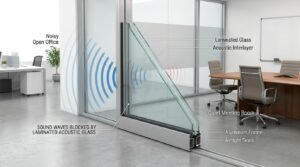
Office Glass Partition Acoustic Performance refers to the capability of a glass partition system to limit airborne sound from passing between adjacent spaces. Rather than evaluating appearance alone, architects and acoustic consultants measure how effectively a partition blocks conversations, office equipment noise, and meeting discussions. Certified acoustic systems use specialized laminated glass, insulated glazing units, engineered aluminum frames, and precision sealing techniques to achieve measurable improvements in workplace privacy.
The demand for high-performance acoustic office interiors has increased rapidly as hybrid working becomes the standard. Employees frequently alternate between collaborative teamwork, virtual meetings, focused individual work, and confidential discussions. Each activity requires a different acoustic environment. Glass partitions now serve a dual purpose: defining functional spaces while supporting employee comfort through improved sound control. Businesses that prioritize Office Glass Partition Acoustic Performance during the design phase typically experience higher employee satisfaction, better productivity, and improved client confidence.
This comprehensive guide explains every major aspect of Office Glass Partition Acoustic Performance, including sound transmission principles, STC ratings, glazing technologies, acoustic laminated glass, double-glazed systems, framing design, installation best practices, maintenance requirements, common specification mistakes, and real-world commercial applications. By the end of this guide, you will understand how to select the right partition system for modern office environments while balancing aesthetics, functionality, and acoustic excellence.
Understanding Office Glass Partition Acoustic Performance
What Is Office Glass Partition Acoustic Performance?
At its core, Office Glass Partition Acoustic Performance measures how effectively a partition system reduces airborne sound transmission between two enclosed spaces. While many people associate glass with openness and transparency, modern acoustic engineering demonstrates that glass partitions can also provide impressive levels of speech privacy when designed correctly.
Acoustic performance depends on much more than glass thickness. Every component of the partition contributes to the final result, including the glazing type, frame construction, perimeter seals, ceiling connections, floor interfaces, and door assemblies. If any one of these components performs poorly, the overall acoustic effectiveness of the partition decreases significantly.
Professional acoustic consultants evaluate partition systems using standardized laboratory testing. Rather than relying on subjective impressions of quietness, they measure sound reduction across a wide frequency range before assigning internationally recognized acoustic ratings. These ratings allow architects and business owners to compare products objectively.
Understanding Office Glass Partition Acoustic Performance helps organizations make informed purchasing decisions. Instead of choosing partitions solely for their appearance, decision-makers can balance aesthetics with measurable improvements in workplace privacy and productivity.
Why Acoustic Performance Matters in Modern Offices
Noise is one of the most common complaints in contemporary workplaces. Employees working in open environments often struggle with concentration because conversations, telephone calls, and collaborative discussions travel freely across the office. Even moderate background noise can reduce focus, increase stress, and negatively affect work quality.
Installing partitions with strong Office Glass Partition Acoustic Performance creates quieter work environments without sacrificing openness. Staff members can collaborate in dedicated meeting rooms while neighboring teams continue working without unnecessary distractions. This balance supports both teamwork and individual productivity.
Privacy is equally important. Human resources discussions, executive meetings, legal consultations, financial planning sessions, and client negotiations all involve confidential information. High-performance acoustic glass partitions help prevent sensitive conversations from being overheard while maintaining an elegant, transparent architectural appearance.
The rise of hybrid work has made acoustics even more important. Employees frequently participate in video conferences from enclosed meeting rooms. Poor sound isolation allows background conversations to interfere with virtual meetings, reducing professionalism and communication quality. Premium acoustic partition systems minimize these issues, supporting both in-person and remote collaboration.
The Business Benefits of Superior Acoustic Design
Organizations investing in premium Office Glass Partition Acoustic Performance often experience measurable operational benefits. Improved speech privacy increases employee confidence during confidential discussions while reducing the risk of sensitive information being overheard. This is particularly valuable in industries such as finance, healthcare, consulting, and legal services.
Better acoustic environments also contribute to employee wellbeing. Reduced noise levels improve concentration, decrease cognitive fatigue, and create more comfortable workplaces. Employees working in acoustically optimized offices often report higher job satisfaction and greater productivity throughout the working day.
Commercial property owners also benefit. Premium acoustic partition systems increase the perceived quality of office interiors, making commercial spaces more attractive to prospective tenants. As flexible workplaces continue evolving, demand for acoustically effective glass partitions is expected to grow across corporate, educational, healthcare, and government sectors.
Finally, investing in certified acoustic systems during initial construction typically proves more cost-effective than retrofitting inadequate partitions after occupancy. Early planning minimizes disruption while delivering long-term value throughout the life of the building.

The Science Behind Sound Transmission
Sound travels through air as pressure waves. When these waves reach a glass partition, some energy reflects back into the original room, some is absorbed by the glass, and some passes through into the adjacent space. The proportion of reflected, absorbed, and transmitted energy determines the partition’s overall acoustic performance.
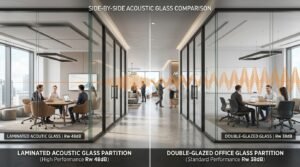
Glass behaves differently from many other construction materials because it can vibrate when exposed to sound. These vibrations may transfer acoustic energy unless the partition incorporates specialized damping technologies. Acoustic laminated glass uses advanced polymer interlayers to reduce vibration, while double-glazed systems introduce insulating cavities that further interrupt sound transmission.
Framing systems also influence acoustic behavior. Precision-engineered aluminum frames with continuous acoustic seals minimize air leakage while reducing structural vibration transfer. Even the smallest gaps around the perimeter can significantly reduce overall Office Glass Partition Acoustic Performance, highlighting the importance of professional installation and careful detailing.
Understanding the science behind sound transmission helps architects and business owners appreciate why complete partition systems outperform isolated product upgrades. Acoustic excellence results from integrating glazing, framing, sealing, and installation into one coordinated solution.