
Glass has become one of the most important construction materials in modern architecture. From residential windows and shower enclosures to commercial storefronts, skyscrapers, railings, and automotive applications, glass delivers aesthetics, natural light, and functionality. However, when safety becomes the primary concern, the debate surrounding Tempered vs Laminated Glass immediately emerges.
Many property owners assume that all safety glass performs the same way. In reality, tempered and laminated glass are engineered using completely different manufacturing processes and are designed to solve different safety challenges. Choosing the wrong type can expose a building to increased risks from accidental impacts, storms, forced entry attempts, break-ins, falling debris, and even severe weather events.
The question, “Which is safer?” is more complex than it appears. Safety can mean protection from injury, resistance against break-ins, defense against hurricanes, noise reduction, UV protection, or structural integrity after breakage. Depending on the specific situation, one glass type may outperform the other significantly.
Understanding the distinction between these materials is critical for architects, contractors, facility managers, and homeowners making construction or renovation decisions. A school entrance, for example, requires different safety priorities than a shower enclosure. Similarly, a hurricane-prone coastal property demands different performance characteristics than an office building in a low-risk urban environment.
This comprehensive guide explores every aspect of Tempered vs Laminated Glass, including manufacturing methods, safety characteristics, breakage patterns, security performance, durability, building code considerations, installation environments, maintenance requirements, costs, and real-world applications. By the end, you will have a complete framework for determining which glass solution offers the highest level of protection for your specific project.

Understanding Safety Glass Fundamentals
What Makes Glass a Safety Material?
Traditional annealed glass presents significant hazards when broken. Upon impact, it fractures into large, sharp shards capable of causing severe injuries. This inherent risk led manufacturers and building regulators to develop specialized safety glass products that minimize injury and improve building performance.
Safety glass achieves its protective properties through either thermal treatment or lamination technology. These engineering methods fundamentally alter how the glass behaves under stress, impact, and breakage conditions.
The primary objective of safety glass is not necessarily preventing breakage. Instead, it focuses on controlling the manner in which breakage occurs. Properly engineered safety glass reduces the likelihood of serious injury while improving overall building security and performance.
Modern construction increasingly relies on safety glass because building codes have become more stringent. Areas subject to human impact, such as doors, sidelights, railings, and shower enclosures, often require safety glazing solutions by regulation.
Why Glass Safety Matters More Than Ever
Modern buildings feature larger glass surfaces than ever before. Floor-to-ceiling windows, frameless partitions, glass facades, and expansive storefront systems have increased public exposure to glazing materials.
As architectural trends continue emphasizing transparency and daylighting, safety considerations become increasingly important. Larger glass panels experience greater stress loads and present higher risks if improperly specified.
Climate change has also intensified severe weather events. Hurricanes, windstorms, hailstorms, and flying debris now influence glazing decisions in many regions. Building owners increasingly seek glass systems capable of maintaining structural integrity during extreme conditions.
Additionally, security threats have driven demand for stronger glazing systems. Retail businesses, schools, government facilities, and luxury homes often require enhanced protection against forced entry attempts and vandalism.
What Is Tempered Glass?
How Tempered Glass Is Manufactured
Tempered glass begins as standard float glass. The glass is cut, shaped, polished, and prepared before entering a specialized tempering furnace. During this process, temperatures exceed 620°C (approximately 1,148°F).
After heating, the glass undergoes rapid cooling using high-pressure air jets. This sudden cooling creates a unique stress profile. The outer surfaces enter compression while the interior core remains under tension.
This engineered stress distribution dramatically increases strength. Tempered glass typically becomes four to five times stronger than standard annealed glass of equal thickness.
Because the tempering process permanently alters the glass structure, any cutting, drilling, or modification must occur before tempering. Post-tempering modifications generally cause catastrophic failure.
Key Safety Characteristics of Tempered Glass
The most recognizable feature of tempered glass is its breakage pattern. Instead of forming dangerous shards, it shatters into thousands of small pebble-like fragments.
This characteristic significantly reduces severe laceration risks. The small particles have blunt edges compared to traditional glass shards, making injuries less likely and generally less serious.
Tempered glass also exhibits excellent impact resistance under normal operating conditions. Its increased strength enables it to withstand accidental bumps, door slams, and moderate impacts better than standard glass.
Because of these properties, tempered glass is widely used in locations where accidental human contact is likely.
Common Applications of Tempered Glass
Tempered glass appears extensively throughout residential and commercial construction. Shower doors represent one of the most common applications due to frequent human contact and moisture exposure.
Glass railings, tabletops, storefront doors, office partitions, and patio doors frequently incorporate tempered glazing. Automotive side windows also commonly use tempered glass because of its safe breakage behavior.
Sports facilities, schools, shopping centers, and public buildings often select tempered glass where occupant safety is the primary concern.
The combination of strength, affordability, and injury reduction makes tempered glass one of the most widely used safety glazing products in the world.
What Is Laminated Glass?
How Laminated Glass Is Manufactured
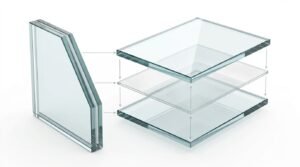
Laminated glass uses an entirely different engineering approach. Instead of modifying internal stress patterns, manufacturers bond multiple glass layers together using an interlayer material.
The most common interlayer is polyvinyl butyral (PVB), although other advanced materials such as ionoplast and EVA are also used. The glass and interlayer are assembled into a sandwich structure.
The assembly then undergoes heat and pressure treatment inside an autoclave. This process permanently bonds the layers into a unified composite material.
The result is a highly durable glazing system capable of maintaining integrity even after severe breakage.
Unique Safety Features of Laminated Glass
Unlike tempered glass, laminated glass remains largely intact when broken. The interlayer holds fractured pieces together instead of allowing them to fall away.
This characteristic dramatically improves post-breakage safety. Even when heavily damaged, the glass often continues serving as a barrier against intrusion, weather, and falling debris.
The retained fragments reduce injury risks while preventing dangerous openings from forming immediately after impact.
This ability to stay in place makes laminated glass especially valuable in high-security and high-risk environments.
Additional Performance Benefits
Laminated glass offers benefits extending beyond safety. The interlayer absorbs sound vibrations, creating excellent acoustic insulation.
Buildings located near airports, highways, rail lines, and urban centers frequently utilize laminated glass to reduce noise transmission.
The interlayer also blocks a significant percentage of ultraviolet radiation. This helps protect furniture, flooring, artwork, and interior finishes from fading.
These secondary performance benefits often justify the higher cost associated with laminated glazing systems.

Tempered vs Laminated Glass Safety Comparison
Impact Resistance
When comparing Tempered vs Laminated Glass, impact resistance represents a major consideration. Tempered glass withstands significant force before breaking because of its compression-strengthened surfaces.
Under moderate impacts, tempered glass frequently outperforms standard laminated configurations. This makes it ideal for environments where accidental impacts are common.
However, once the impact threshold is exceeded, tempered glass shatters completely. The entire panel typically fails simultaneously.
Laminated glass may crack more readily under certain impacts, but it continues functioning as a barrier after breakage. This distinction becomes critical in security and severe weather scenarios.
Injury Prevention
From an injury prevention standpoint, both products qualify as safety glass, yet they achieve safety differently.
Tempered glass minimizes injury by producing small fragments rather than dangerous shards. Occupants exposed to broken tempered glass generally experience less severe injuries.
Laminated glass minimizes injury by preventing fragment separation altogether. Broken pieces adhere to the interlayer rather than becoming airborne hazards.
Many experts consider laminated glass superior for injury prevention because it reduces both laceration risks and falling glass hazards.
Post-Breakage Performance
Post-breakage behavior often determines the safest option in critical applications.
Tempered glass completely loses structural integrity after failure. Once shattered, the opening becomes fully exposed.
Laminated glass often remains intact even after repeated impacts. The interlayer continues holding broken fragments together, preserving the building envelope.
This retained protection can prevent injuries, theft, water intrusion, and weather damage following breakage.

Security and Forced Entry Protection
Why Security Glass Matters
Modern security concerns have transformed glazing selection criteria. Property owners increasingly seek solutions capable of delaying or preventing unauthorized entry.
Traditional glass provides little resistance against determined attackers. Safety glass improves protection, but performance varies dramatically between products.
Security professionals evaluate glazing systems based on penetration resistance, attack duration, and post-breakage integrity.
These metrics reveal substantial differences between tempered and laminated glass.
Tempered Glass Security Performance
Tempered glass offers impressive strength prior to breakage. However, once failure occurs, the opening becomes immediately accessible.
An intruder capable of generating sufficient impact force can often create an entry point rapidly.
While tempered glass may delay initial penetration, it provides limited post-breakage resistance.
For this reason, security consultants rarely recommend tempered-only solutions in high-risk environments.
Laminated Glass Security Performance
Laminated glass excels in forced entry scenarios. Even after cracking, the interlayer remains intact and continues resisting penetration attempts.
Intruders frequently require multiple strikes and substantial effort to create a passable opening.
This delay can prove crucial. Additional time increases the likelihood of detection, alarm activation, and law enforcement response.
Consequently, banks, jewelry stores, government buildings, and luxury residences often favor laminated security glazing systems.

Weather Resistance and Natural Disaster Protection
Hurricane Performance
Coastal regions face unique glazing challenges. Windborne debris can transform ordinary objects into high-speed projectiles during storms.
Tempered glass may resist initial impacts but typically creates a complete opening when failure occurs.
Laminated glass often remains attached to its frame even after cracking. This helps maintain building envelope integrity during severe weather.
As a result, many hurricane-resistant window systems incorporate laminated glazing.
Tornado and Storm Protection
Extreme weather events generate substantial pressure fluctuations and flying debris hazards.
When a window opening forms during a storm, internal pressures can increase dramatically, potentially contributing to structural failure.
Laminated glass helps prevent sudden pressure changes by maintaining a protective barrier even after impact.
This capability significantly improves occupant safety during severe weather emergencies.
Protection Against Falling Debris
Urban environments present risks from construction materials, tree branches, and accidental impacts.
Laminated glass reduces the likelihood of falling shards because fragments remain bonded to the interlayer.
This characteristic enhances pedestrian safety around high-rise buildings and public spaces.

Acoustic and Environmental Performance
Noise Reduction Capabilities
Noise pollution affects comfort, productivity, and property value.
The interlayer in laminated glass acts as a vibration dampener, reducing sound transmission through glazing assemblies.
This performance advantage becomes particularly valuable near transportation corridors and commercial districts.
Tempered glass alone offers limited acoustic enhancement compared to laminated systems.
UV Protection Benefits
Ultraviolet radiation contributes significantly to interior fading and material degradation.
Laminated glass blocks most UV rays while maintaining visible light transmission.
Homeowners often notice improved preservation of furniture, flooring, and artwork when laminated glazing is installed.
Tempered glass lacks comparable UV-filtering performance unless combined with additional coatings.
Energy Efficiency Considerations
Modern glazing systems frequently combine safety features with energy-efficient technologies.
Both tempered and laminated products can integrate low-emissivity coatings and insulated glass configurations.
However, laminated glass often provides additional comfort benefits through noise reduction and solar control enhancements.
Cost Analysis: Tempered vs Laminated Glass
Initial Installation Costs
Tempered glass generally costs less than laminated glass.
Manufacturing processes for tempered products are relatively straightforward and highly scalable.
Laminated glass requires additional materials, bonding procedures, quality control measures, and processing steps.
These factors contribute to higher purchase prices.
Long-Term Value Assessment
Initial cost should never be the sole decision factor.
Laminated glass often delivers long-term value through enhanced security, noise reduction, UV protection, and storm resistance.
These benefits may reduce maintenance expenses, insurance risks, and replacement frequency.
Evaluating lifecycle costs frequently changes the economic comparison.
Return on Investment
For standard residential applications, tempered glass may provide sufficient performance at a lower cost.
For premium properties, commercial facilities, and security-sensitive environments, laminated glass often delivers superior returns through risk reduction and enhanced occupant protection.
Decision-makers should evaluate both immediate expenditures and long-term operational benefits.
Advanced Case Study and Real-World Applications
Real-World Comparison: Coastal Luxury Home
Consider a luxury beachfront residence located in a hurricane-prone region. The owner initially planned to install tempered glass throughout the property due to its strength and lower cost. However, a comprehensive risk assessment revealed several concerns.
The home faced exposure to hurricane-force winds, airborne debris, saltwater conditions, and elevated security risks during seasonal vacancies. Although tempered glass offered excellent impact resistance, complete failure during severe storms could expose the interior to catastrophic damage.
The project team ultimately selected laminated glass for exterior windows and doors. During a subsequent tropical storm, several windows sustained significant impacts from flying debris. The outer glass layers cracked, yet the laminated assemblies remained largely intact.
The retained barrier prevented wind infiltration and water intrusion. Interior furnishings remained protected, and repair costs were substantially lower than anticipated. Insurance assessors noted that the glazing system contributed significantly to minimizing storm-related damage.
A separate evaluation involved the home’s interior shower enclosures and glass partitions. Here, tempered glass remained the preferred choice due to its lower cost, excellent safety performance, and suitability for environments with frequent human contact.
This project illustrates a critical lesson: the safest glass depends on the application. Laminated glass delivered superior protection against weather and security threats, while tempered glass provided practical safety for interior applications.
The outcome demonstrates why architects increasingly combine both technologies strategically rather than viewing them as mutually exclusive alternatives.
Tempered vs Laminated Glass for Residential Applications
When evaluating Tempered vs Laminated Glass for residential projects, homeowners must consider safety, security, comfort, and long-term value. The decision between Tempered vs Laminated Glass often depends on the specific room and potential risks associated with that space.
For living rooms and large windows, the Tempered vs Laminated Glass comparison becomes especially important because these areas typically contain expensive furniture and receive significant sunlight. Laminated glass offers superior UV protection, while tempered glass provides excellent impact resistance.
Many architects recommend analyzing Tempered vs Laminated Glass requirements separately for each part of the home. Exterior windows often benefit from laminated glass, while shower enclosures and interior doors commonly use tempered glass.
Tempered vs Laminated Glass for Commercial Buildings
The debate over Tempered vs Laminated Glass becomes more complex in commercial construction. Business owners must evaluate security concerns, building code requirements, and occupant safety standards before making a final decision.
In retail environments, Tempered vs Laminated Glass is often discussed from a security perspective. Laminated glass provides additional protection against forced entry, making it attractive for storefronts and high-value businesses.
Office buildings frequently perform a detailed Tempered vs Laminated Glass assessment to balance aesthetics, performance, and lifecycle costs. The correct choice can significantly improve building safety and operational efficiency.
Frequently Asked Questions
Is laminated glass always safer than tempered glass?
Safety depends on the definition being used. If the goal is injury reduction from accidental breakage, both products perform exceptionally well. Tempered glass breaks into small fragments, reducing severe laceration risks. Laminated glass retains fragments on an interlayer, preventing dangerous shard dispersion.
When evaluating overall protection, many professionals consider laminated glass safer because it continues functioning after breakage. The retained barrier helps prevent unauthorized entry, weather intrusion, and falling debris hazards. However, tempered glass remains highly effective for many residential and commercial applications.
Project-specific risks should determine the final selection. Interior shower doors, for example, often benefit from tempered glass, while exterior security-sensitive applications frequently favor laminated glazing.
Which glass is better for home windows?
The answer depends on location, security requirements, and budget. Homes in low-risk areas may perform perfectly well with tempered glass where code compliance requires safety glazing.
Properties exposed to hurricanes, severe storms, heavy traffic noise, or elevated security concerns often benefit more from laminated glass. The additional protection against break-ins and weather-related impacts can justify the increased investment.
Many premium homes now incorporate laminated glass throughout exterior glazing systems because of its combined safety, acoustic, and UV-blocking benefits.
Can laminated glass stop burglars?
Laminated glass significantly improves burglary resistance compared to standard or tempered glass. Even after cracking, the interlayer remains intact and continues resisting penetration attempts.
While no glazing system is completely impenetrable, laminated glass substantially increases the time and effort required to gain entry. This delay improves the effectiveness of alarms, surveillance systems, and law enforcement response.
Security-focused facilities commonly rely on laminated glazing because of its proven ability to resist forced-entry attacks.
Why does tempered glass shatter completely?
Tempered glass contains engineered internal stresses created during rapid cooling. These stresses increase strength under normal conditions but cause the entire panel to release stored energy when failure occurs.
The result is a characteristic fragmentation pattern consisting of thousands of small pieces. This behavior is intentional and serves as a safety feature designed to minimize severe injuries.
Although dramatic in appearance, this breakage pattern is one of the primary reasons tempered glass qualifies as safety glass.
Is laminated glass more expensive?
Yes, laminated glass generally costs more than tempered glass. Additional materials, interlayers, manufacturing processes, and quality control requirements contribute to higher production costs.
However, the price difference should be evaluated against performance benefits. Enhanced security, UV protection, sound reduction, and storm resistance often justify the additional investment.
For many commercial and high-end residential projects, the long-term value outweighs the higher upfront expense.
Can tempered and laminated glass be combined?
Absolutely. Manufacturers frequently produce laminated assemblies using tempered glass layers. This hybrid solution combines the strength of tempered glass with the retention capabilities of laminated construction.
Such systems provide exceptional impact resistance, security performance, and post-breakage integrity. They are commonly used in hurricane-resistant glazing, high-security facilities, and demanding architectural applications.
Although more expensive, combined systems often represent the highest-performing safety glazing option available.
Building Codes and Tempered vs Laminated Glass Requirements
Building codes play a major role in determining whether Tempered vs Laminated Glass should be installed in a specific location. Regulations vary by jurisdiction but generally focus on reducing injury risks and improving occupant protection.
Understanding local requirements for Tempered vs Laminated Glass helps architects and contractors avoid costly compliance issues. Safety glazing standards continue evolving as building technologies advance.
Many modern code frameworks recognize that Tempered vs Laminated Glass each offer unique advantages. As a result, regulations often specify performance criteria rather than requiring one specific product type.
Final Verdict on Tempered vs Laminated Glass Safety
After examining all major performance categories, the Tempered vs Laminated Glass comparison reveals that both products are highly effective safety glazing solutions. However, their strengths differ considerably.
If the primary objective is injury reduction from accidental breakage, the Tempered vs Laminated Glass decision may favor tempered glass due to its fragmentation pattern and lower cost.
If security, storm resistance, and post-breakage protection are priorities, the Tempered vs Laminated Glass comparison strongly favors laminated glass. Its ability to remain intact after impact provides a higher level of overall protection.
Ultimately, the answer to the Tempered vs Laminated Glass question depends on project goals, risk exposure, budget considerations, and long-term performance requirements.
Conclusion & Roadmap Forward
The debate surrounding Tempered vs Laminated Glass cannot be resolved with a universal answer because safety requirements vary significantly between applications. Tempered glass excels in strength, affordability, and injury reduction through controlled fragmentation. It remains one of the most practical solutions for shower doors, interior partitions, railings, and numerous everyday safety glazing applications.
Laminated glass, however, offers a broader definition of safety. By maintaining structural integrity after breakage, it provides superior protection against forced entry, severe weather, falling debris, and accidental impact hazards. Its additional benefits, including UV filtering and sound reduction, further strengthen its value proposition.
For homeowners, architects, and building professionals, the most effective strategy is application-based selection. Evaluate the specific risks associated with the environment, occupancy type, security requirements, weather exposure, and budget constraints. In many modern projects, the optimal solution involves using both technologies strategically rather than choosing one exclusively.
Ultimately, if your primary concern is post-breakage protection, security, and resilience, laminated glass often emerges as the safer option. If your focus is impact resistance, cost efficiency, and occupant safety in everyday environments, tempered glass remains an outstanding choice. By understanding these distinctions, you can make informed decisions that maximize both safety and long-term performance.